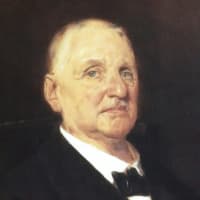
Anton Bruckner
Romantic · 1824–1896
For most of his life Anton Bruckner earned his living at the organ, not the writing desk. Born in the Austrian village of Ansfelden in 1824, the son of a schoolteacher, he worked his way up from country schoolmaster to organist at the monastery of St. Florian and then at Linz cathedral, and he remained a devout Catholic whose faith is audible in everything he wrote.
He moved to Vienna at 44 to teach at the conservatory and, remarkably late, to make his real start as a symphonist. The symphonies he produced there are long, patient, and built like cathedrals: vast spans of sound that grow, fall silent, and grow again. Stung by criticism, he revised them over and over, which is why many exist in competing versions.
Begin with the Symphony no. 4 in E flat major, the one he called Romantic, then move to the Symphony no. 7 in E major, whose long opening melody is one of his most welcoming.
62 works in the catalog, across 4 genres. Log what you listen to with Opus, the classical music journal for iPhone.
Chamber
- Aequale no. 1 in C major, WAB 114 For trombone ensemble
- Aequale no. 2 in C minor, WAB 149 For trombone ensemble
- Intermezzo in D minor, WAB 113 For string quintet
- Prayer and Halleluja For brass ensemble
- Rondo in C minor For string quartet
- String Quartet in C minor, WAB 111
- String Quintet in F major, WAB 112
Keyboard
- Erinnerung in A flat major, WAB 117
- Fantasie in G major, WAB 118
- Klavierstück in E flat major, WAB 119
- Lancier-Quadrille in C major, WAB 120
- Prelude and Fugue in C minor, WAB 131
- Prelude in C major, WAB 129, "Preg Prelude"
- Sonata Movements in G minor
- Steiermärker in G major, WAB 122
- Stille Betrachtung an einem Herbstabend, WAB 123
Orchestral
- Symphony no. 4 in E flat major, WAB 104, "Romantic"
- Symphony no. 5 in B flat major, WAB 105
- Symphony no. 7 in E major, WAB 107
- Symphony no. 8 in C minor, WAB 108
- Symphony no. 9 in D minor, WAB 109
- March in E flat major, WAB 116 For band
- Overture in G minor, WAB 98
- Symphony no. 0 in D minor, WAB 100
- Symphony no. 00 in F minor, WAB 99
- Symphony no. 1 in C minor, WAB 101
- Symphony no. 2 in C minor, WAB 102
- Symphony no. 3 in D minor, WAB 103
- Symphony no. 6 in A major, WAB 106
Vocal
- Te Deum, WAB 45
- Abendzauber, WAB 57
- Afferentur regi, WAB 1 Offertory
- Ave Maria, WAB 5 Offertory
- Ave Maria, WAB 6 Offertory
- Christus factus est, WAB 10 Gradual
- Christus factus est, WAB 11 Gradual
- Das deutsche lied, WAB 63
- Der Abendhimmel, WAB 56
- Ecce sacerdos, WAB 13 Antiphon
- Helgoland, WAB 71 For chorus and orchestra
- Iam lucis orto sidere, WAB 18
- In jener letzten der Nächte, WAB 17
- Inveni David, WAB 19 Offertory
- Libera me, Domine, WAB 21
- Locus iste, WAB 23
- Mass in C major, WAB 25, "Windhaager Messe"
- Mass no. 1 in D minor, WAB 146
- Mass no. 2 in E minor, WAB 27
- Mass no. 3 in F minor, WAB 28
- Mitternacht, WAB 80
- O du liebes Jesukind, WAB 145
- Os justi, WAB 30 Gradual
- Pange lingua, WAB 32
- Pange lingua, WAB 33
- Psalm 150, WAB 38 For soprano, chorus and orchestra
- Salvum fac populum, WAB 40 Antiphon
- Tantum ergo, WAB 32
- Tantum ergo, WAB 43
- Tota pulchra es, WAB 46 Antiphon
- Um Mitternacht, WAB 89
- Vexilla regis prodeunt, WAB 51
- Virga Jesse, WAB 52 Gradual
Listening guides
Related composers


Keep a listening journal.
Opus is free on the App Store.