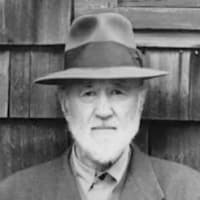
Charles Ives
20th Century · 1874–1954
Charles Ives sold insurance for a living, and did it very well: his New York firm was among the most successful in the country. Composing happened on nights, weekends, and commuter trains. Born in Danbury, Connecticut in 1874, he learned music from his bandmaster father, who liked experiments such as having two bands march past each other playing different tunes. That collision of sounds became Ives's signature.
His pieces weave in the hymns, marches, and parlor songs of his New England childhood, often stacked on top of each other in ways no one else was attempting at the time. Almost nobody heard this music when he wrote it. Recognition arrived decades later, including a Pulitzer Prize in 1947 for a symphony he had finished some forty years earlier.
Start with the Symphony no. 2, his most welcoming work, then The Unanswered Question, a short, haunting piece for trumpet, winds, and strings.
282 works in the catalog, across 4 genres. Log what you listen to with Opus, the classical music journal for iPhone.
Chamber
- String Quartet no. 2
- A Set of 3 Short Pieces, for string quartet, double bass, and piano
- Chamber Set no. 4
- From the Steeples and the Mountains, for 1 or 2 trumpets, trombone, 4 sets of bells and 2 pianos
- Hallowe'en, for string quartet, piano and optional drum
- In Re Con Moto et al., for string quartet, piano and optional drum
- Largo, for violin, clarinet and piano
- Piano Trio
- Scherzo, for string quartet
- Scherzo: Holding Your Own, for string quartet
- String Quartet no. 1: From the Salvation Army
- The Gong on the Hook and Ladder or Firemen's Parade on Main Street, for strings, piano and optional bell
- Tone Roads, for chamber orchestra, op. 49
- Trio, for violin, cello and piano
- Violin Sonata no. 1
- Violin Sonata no. 2
- Violin Sonata no. 3
- Violin Sonata no. 4: Children's Day At the Camp Meeting
Keyboard
- Piano Sonata no. 2, "Concord"
- 'Adeste Fideles' in an Organ Prelude
- 3 Quarter-Tone Pieces, for 2 pianos
- 3-Page Sonata
- Allegretto: Invention
- Anthem: Processional
- Bad Resolutions and Good
- Baseball Take-Off
- Emerson
- Emerson
- Fugue in C minor, for organ
- Fugue in E flat major, for organ
- March no. 6 with 'Here's to Good Old Yale', for piano
- Piano Sonata no. 1
- Rough and Ready
- Scene Episode
- Set of Five Take-Offs, for piano
- Sonata no. 1
- Song Without Words
- Storm and Distress
- Study no. 2: Andante moderato-Allegro molto, etude for piano
- Study no. 5
- Study no. 6
- Study no. 7
- Study no. 8
- Study no. 9: The Anti-Abolitionist Riots in the 1830s and 1840s, for piano
- Study no. 15
- Study no. 18
- Study no. 20: March
- Study no. 21: Some Southpaw Pitching, etude for piano
- Study no. 22: Andante maestoso. Allegro vivace, etude for piano
- Study no. 23: Allegro, etude
- The Alcotts
- The Celestial Railroad, take off for piano
- The Seen and Unseen
- Three-Page Sonata, for piano
- Variations on 'America,' for organ
- Varied Air and Variations, for piano
- Waltz-Rondo
- Waltz: Rondo
Orchestral
- A Symphony: New England Holidays
- Central Park in the Dark
- Orchestral Set no. 1: 3 Places in New England
- Symphony no. 2
- Symphony no. 4
- The Unanswered Question, for trumpet, winds, and string orchestra
- Charlie Rutlage, for orchestra and optional voice
- Country Band March, for theater orchestra
- Emerson Overture, for piano and orchestra
- Fantasia on 'Jerusalem the Golden', for band
- March 'Intercollegiate' with 'Annie Lisle', for band
- March: The Circus Band, for orchestra and optional chorus
- March in F and C with 'Omega Lambda Chi', for band
- March no. 2 with 'Son of a Gambolier', for band
- Old Home Days, 5 suites for band
- Orchestral Set no. 2
- Orchestral Set no. 3
- Overture and March: '1776', for theater orchestra
- Overture in G minor
- Postlude in F major
- Robert Browning Overture
- Runaway Horse on Main Street, take-off for band
- Symphony no. 1 in D minor
- Symphony no. 3: The Camp Meeting
- The General Slocum
- The Gong on the Hook and Ladder or Firemen's Parade on Main Street
- The Pond
- Universe Symphony, for large orchestra divided in to smaller ensembles and percussion
- Yale-Princeton Football Game
Vocal
- 1, 2, 3
- Abide with me
- A Christmas Carol
- A Christmas Carol
- Aeschylus and Sophocles
- A Farewell to Land
- Allegro
- Amphion
- A Night Song
- A Night Thought
- Ann Street
- An Old Flame
- A Perfect Day
- A Scotch Lullaby
- A Sea Dirge
- A Song - For Anything
- A Son of A Gambolier
- At Parting
- At Sea
- At the River
- August
- Autumn
- Because of You
- Because Thou Art
- Berceuse
- Canon: Not only in my lady's eyes
- Canon: Oh! the days are gone, when beauty bright
- Chanson de Florian
- Charlie Rutlage
- Country Celestial
- Cradle Song
- Crossing the Bar, for chorus and organ
- December
- Die Lotosblume
- Disclosure
- Down East
- Dreams
- Du alte Mutter
- Du bist wie eine Blume
- Ein Ton
- Election
- Evening
- Evidence
- Far from my heav'nly home
- Far in the wood
- Feldeinsamkeit
- Flag Song
- Forward into Light
- Friendship
- Frühlingslied
- General William Booth Enters into Heaven
- General William Booth Enters into Heaven, for chorus, optional solo voice, chamber orchestra and percussion
- God Bless and Keep Thee
- Grace
- Grantchester
- Gruss
- Harpalus
- He Is There!
- Her Eyes
- Her gown was of vermilion silk
- His Exaltation
- Hymn
- Hymn of Trust
- Ich grolle nicht
- I knew and loved a maid
- Ilmenau
- Immortality
- In April-tide
- In Autumn
- In Flanders Fields
- In My Beloved's Eyes
- In the Alley
- Kären
- La Fede
- Like a Sick Eagle
- Lincoln, the Great Commoner
- Lincoln, the Great Commoner, for chorus and orchestra
- Lord God, They Sea Is Mighty, anthem for chorus and organ
- Luck and Work
- Majority
- Maple Leaves
- Marie
- Marie
- Memories
- Minnelied
- Mirage
- Mists
- My Lou Jennine
- My Native Land
- My Native Land
- Nature's Way
- Naught that country needeth,
- Night of Frost in May
- No More
- Nov. 2, 1920
- Old Home Day
- Omens and Oracles
- On Judges' Walk
- On the Antipodes, for voice and 2 pianos
- On the Counter
- Paracelsus
- Peaks
- Pictures
- Premonitions
- Processional: Let There Be Light, for chorus and organ
- Psalm 14, for double chorus
- Psalm 24
- Psalm 25, for chorus and organ
- Psalm 42, for solo voice, chorus and organ
- Psalm 54
- Psalm 67
- Psalm 90, for chorus, bells, and organ
- Psalm 100, for double chorus
- Psalm 135, for chorus, brass, organ and percussion
- Psalm 150, for female chorus, chorus and optional organ
- Qu'il m'irait bien
- Religion
- Remembrance
- Requiem
- Resolution
- Rock of Ages
- Romanzo
- Rosenzweige
- Rough Wind
- Sehnsucht
- September
- Serenity
- Serenity, for chorus, harps and violins and timpani
- She is Not Fair to Outward View
- Slow March
- Slugging a Vampire
- Soliloquy Song
- Song for Harvest Season, for voice and brass ensemble
- Songs My Mother Taught Me
- South Wind
- Spring Song
- Sunrise, for voice, piano and violin
- Swimmers
- Tarrant Moss
- The All-Enduring
- The Cage
- The Camp Meeting
- The Children's Hour
- The Circus Band
- The Collection
- The Ending Year
- The Greatest Man
- The Housatonic at Stockbridge
- The Incantation
- The Indians
- The Innate
- The Last Reader
- The Light That is felt
- The Love Song of Har Dyal
- The New River
- The Old Mother
- The One Way
- The Only Son
- The Rainbow
- There is a Certain Garden
- There is a Lane
- The Sea of Sleep
- The See'r
- The Side Show
- The Song of the Dead
- The Things Our Fathers Loved
- The Waiting Soul
- The White Gulls
- The World's Highway
- The World's Wanderers
- They Are There!
- They Are There!, for chorus and orchestra
- Thoreau
- Those Evening Bells
- Through Night and Day
- To Edith
- Tolerance
- Tom Sails Away
- Two Little Flowers
- Two Slants
- Vote for Names, for voice and 3 pianos
- Walking
- Walt Whitman
- Waltz
- Watchman
- Weil' auf mir
- West London
- When Stars are in the Quiet Skies
- Where the Eagle Cannot See
- Widmung
- Wiegenlied
- Wie Melodien zieht es mir
- William Will
- Yellow Leaves
- Élégie
Related composers


Keep a listening journal.
Opus is free on the App Store.