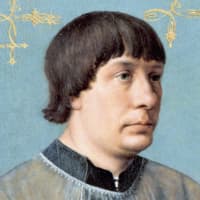
Jacob Obrecht
Renaissance · 1450–1505
Jacob Obrecht came from Ghent, in present-day Belgium, where his father was a city trumpeter. He made his living as a priest and choirmaster, holding church posts in Bruges, Antwerp, and Bergen op Zoom, cities of the prosperous Low Countries whose choirs were then the envy of Europe.
His specialty was the sung Mass, music for unaccompanied choir in which several vocal lines interlock around a borrowed melody, often a popular song of the day hidden inside the texture. Contemporaries prized him for how quickly he worked and how naturally his long, arching lines unfolded. His fame reached Italy, and in 1504 he traveled to the court of Ferrara; within a year the plague swept the city and killed him.
Start with any well-sung recording of his Masses. A cappella church music this old asks a little patience, and then it opens up.
26 works in the catalog. Log what you listen to with Opus, the classical music journal for iPhone.
Vocal
- Beata es Maria
- Factor orbis
- Fors seulement
- Ic draghe de mutse clutse
- Ic ret my uut spacieren
- Inter praeclarissimas virtutes
- J'ay pris amours
- La tortorella
- Laudemus nunc Dominum; Non est hic aliud
- Missa 'Maria zart'
- Missa Caput
- Missa Fortuna desperata
- Missa Sicut spina rosam, mass for 4 voices
- Missa Sub tuum presidium
- Omnes spiritus laudet, office polyphony
- Parce Domine
- Rompeltier
- Salve crux arbor vitae, motet for 5 voices
- Salve regina
- Salve regina
- Salve regina
- Salve sancta facies
- Si sumpsero
- Tant que nostre argent dura, chanson for 4 voices
- Tsat een cleyn meiskin, chanson
- Wat willen wijmetten budel spelen
Related composers


Keep a listening journal.
Opus is free on the App Store.