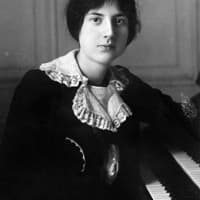
Lili Boulanger
20th Century · 1893–1918
Lili Boulanger was born in Paris in 1893 into a family of musicians; her older sister Nadia went on to teach several generations of composers. Lili's talent was recognized early, but so was her fragile health. A childhood illness left her chronically sick, and she composed for most of her life knowing her time was likely to be short.
In 1913, at nineteen, she became the first woman to win the Prix de Rome for composition, France's top prize for young composers, with Faust et Hélène, a dramatic piece for three singers and orchestra. The prize brought immediate fame. In the five years left to her she wrote steadily: large settings of psalms for chorus and orchestra, songs, and short orchestral pieces. She died in 1918 at twenty-four, dictating her last work to her sister when she was too weak to write.
Start with D'un matin de printemps, a bright orchestral piece from her final year, then try Psaume 130, "Du fond de l'abîme", a big, dark setting of Psalm 130 for chorus and orchestra.
13 works in the catalog, across 4 genres. Log what you listen to with Opus, the classical music journal for iPhone.
Chamber
- Cortège For violin and piano
- Nocturne For violin and piano
Keyboard
- Trois morceaux pour piano
Orchestral
- D'un matin de printemps
- D'un soir triste
Vocal
- Faust et Hélène Cantata
- Pie Jesu
- Psaume 130 "Du fond de l'abîme"
- Clairières dans le ciel Song cycle
- Pour les funérailles d'un soldat For baritone, chorus, and orchestra
- Psaume 129 "Ils m'ont assez opprimé"
- Psaume 24 "La terre appartient à l'Éternel"
- Vieille prière bouddhique For tenor, chorus, and orchestra
Related composers


Keep a listening journal.
Opus is free on the App Store.