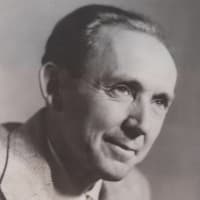
Roy Harris
20th Century · 1898–1979
Roy Harris liked to point out that he was born in a log cabin in Oklahoma on Lincoln's birthday, and the American plainness of that story runs through his music. His family moved to California, where he farmed and drove a delivery truck before finding his way to composition, finishing his training in Paris with the famous teacher Nadia Boulanger.
In the 1930s and 40s he was among the most performed American symphony composers, writing broad, open-spaced music that listeners heard as the sound of the prairie. His reputation later faded, but one work never left the concert hall.
That work is the Symphony no. 3, a single unbroken span of about eighteen minutes, premiered by the Boston Symphony in 1939. It builds from a lone cello line to a granite climax, and it is the natural first stop.
23 works in the catalog, across 4 genres. Log what you listen to with Opus, the classical music journal for iPhone.
Chamber
- Duo for cello and piano
Keyboard
- A Happy Piece for Shirley
- American Ballads I
- American Ballads II
- Little Suite
- Orchestrations
- Piano Piece
- Piano Sonata, op. 1
- Suite in 3 Movements
- Toccata
- True Love Don't Weep
Orchestral
- Symphony no. 3, in 1 movement
- Acceleration, for orchestra
- American Creed, for orchestra
- Epilogue To Profiles in Courage ., for orchestra
- Symphony no. 4
- Symphony no. 5
- Symphony no. 6
- Symphony no. 7
- Symphony no. 9
- When Johnny Comes Marching Home, overture for orchestra
Vocal
- Abraham Lincoln Walks at Midnight, for mezzo-soprano and orchestra
- Mi Khamokha, for tenor, chorus and organ
Related composers


Keep a listening journal.
Opus is free on the App Store.