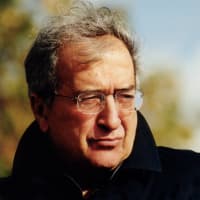
Luciano Berio
Post-War · 1925–2003
Luciano Berio came from a family of organists in Oneglia, on the Italian Riviera, and expected a pianist's career until a hand injury during military training in 1944 pushed him toward composition. In the 1950s he co-founded an electronic music studio at Italian Radio in Milan, one of the first in Europe, and his marriage to the American singer Cathy Berberian shaped much of his writing for the voice.
He is best known for the Sequenzas, a series of solo pieces, one per instrument, each pushing a single player to the edge of what the instrument can do.
Start with Sinfonia, his 1968 work in which eight amplified voices speak and sing over the orchestra, at one point riding an entire movement borrowed from a Mahler symphony. Then hear Sequenza III, a piece for solo voice written for Berberian, made of gasps, laughter, and fragments of song.
65 works in the catalog, across 5 genres. Log what you listen to with Opus, the classical music journal for iPhone.
Chamber
- 2 Pieces, for violin and piano
- 34 Duetti, for 2 violins
- Call, for brass quintet
- Corale on Sequenza VIII, for violin, strings, and 2 horns
- Good Night, for trumpet solo
- Les Mots sont allés, for cello solo
- Lied, for clarinet solo
- Naturale, for viola, marimba, tam-tam and tape
- Opus Number Zoo, for speaker and wind quintet
Keyboard
- 5 Variations
- 5 Variazioni, for piano
- Brin
- Canzonetta for Piano 4-Hands
- Erdenklavier
- Feuerklavier
- Leaf
- Luftklavier
- Petite Suite
- Rounds, for harpsichord
- Rounds, for harpsichord or piano
- Sonata
- Touch, for piano 4-hands
- Wasserklavier
Orchestral
- Boccherini, Ritirata notturna di madrid
- Chemins II on Sequenza VI, for viola and 9 instruments
- Chemins IV on Sequenza VII, for oboe and strings
- Corale on Sequenza VIII, for violin, strings, and 2 horns
- Ekphrasis
- Formazioni
- Il ritorno degli snovidenia, for cello and 30 instruments
- Points on the Curve to Find. . .,for piano and 23 instruments
- Purcell, Hornpipe, "The Modification and Instrumentation of a Famous Hornpipe as a Merry and Altogether Sincere Homage to Uncle Alfred"
- Rendering Based on Schubert's sketches for the Symphony no. 10
- Récit, for alto sax and orchestra
- Serenata I, for flute and 14 instruments
- Solo, for trombone and orchestra
- Variazioni 'Ein Mädchen oder Weibchen', for 2 bassett horns and strings
- Voci, for viola and 2 instrumental groups
Stage
- Linea, ballet for 2 pianos, vibraphone and marimba
Vocal
- Sequenza I, for flute
- Sequenza III, for solo voice
- Sinfonia, for 8 amplified voices and orchestra
- 4 Canzoni popolari, for voice and piano
- A Ronne
- Chamber Music, for soprano, clarinet, cello, and harp
- Coro, for 40 voices and 40 instruments
- Folk Songs, for soprano and chamber ensemble
- O King, for voice, flute, clarinet, violin, cello, and piano
- Prologue, for soloists, chorus and orchestra
- Sequenza II, for harp
- Sequenza IV, for piano
- Sequenza IXa, for clarinet
- Sequenza IXb, for alto saxophone
- Sequenza V, for trombone
- Sequenza VI, for viola
- Sequenza VII, for oboe
- Sequenza VIIb, for soprano saxophone
- Sequenza VIII, for violin
- Sequenza VIII, for violin
- Sequenza X, for trumpet in C and piano resonance
- Sequenza XI, for guitar
- Sequenza XII, for bassoon
- Sequenza XII, for bassoon
- Sequenza XIII, for accordion
- Sequenza XIV, for cello
Related composers


Keep a listening journal.
Opus is free on the App Store.