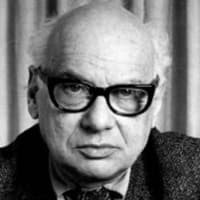
Milton Babbitt
Post-War · 1916–2011
Milton Babbitt grew up in Jackson, Mississippi, studied mathematics before committing to music, and spent his career teaching at Princeton. He believed composition could be as rigorous as research, and he wrote music of dense, intricate patterning, cheerfully unbothered that its audience was small. A magazine famously ran one of his essays under the title Who Cares if You Listen?, a headline he did not choose and disliked.
He was also a pioneer of electronic music, working from the late 1950s with the room-sized RCA synthesizer in New York, one of the first machines that could realize a score exactly. Among his students, improbably, was the Broadway songwriter Stephen Sondheim, and Babbitt kept a lifelong encyclopedic love of American popular song.
Start with Philomel, for soprano and recorded tape, where the myth of a woman transformed into a nightingale becomes a duet between a live singer and her own electronic echoes.
26 works in the catalog, across 4 genres. Log what you listen to with Opus, the classical music journal for iPhone.
Chamber
- Accompanied Recitative, serialized composition for soprano saxophone and piano
- Around the horn, for solo horn
- Beaten Paths, for marimba
- Clarinet Quintet
- Composition for Synthesizer
- Composition for Viola and Piano
- Ensembles for Synthesizer
- Homily, for snare drum
- Melismata, for violin
- None but the Lonely Flute, for flute
- Play It Again Sam, for viola
- Sheer Pluck, for solo guitar
- Soli e Duettini, for flute and guitar
- Whirled Series, for saxaphone and piano
Keyboard
- 3 Compositions
- Canonical Form
- Duet
- Lagniappe
- Partitions
- Post-Partitions
- Reflections, for piano and synthesized tape
- Semi-Simple Variations
- Tableaux
Orchestral
- Correspondences for String Orchestra and Synthesized Tape
Vocal
- Philomel For soprano, taped soprano and synthesizer
- Round
Related composers


Keep a listening journal.
Opus is free on the App Store.