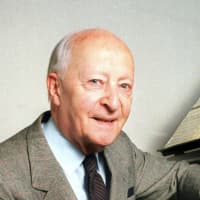
Witold Lutoslawski
Post-War · 1913–1994
Witold Lutosławski lived nearly his whole life in Warsaw, through the city's worst century. During the Nazi occupation he made his living playing piano duets with fellow composer Andrzej Panufnik in Warsaw cafés, one of the few musical outlets permitted. After the war, with modern styles restricted under Stalinism, he wrote folk-based works, including the Concerto for Orchestra that made his name.
From the 1960s he found his mature voice, built on an invention he called limited chance: at certain moments the players repeat their own fragments freely, not synchronized with each other, creating rich, shimmering clouds of sound that the conductor then gathers back into strict time. He tried it first in Jeux vénitiens, and refined it across four symphonies and a series of concertos, conducting his own music worldwide.
Start with the Concerto for Orchestra, his most immediate piece, then the Cello Concerto to hear the later style in full.
59 works in the catalog, across 4 genres. Log what you listen to with Opus, the classical music journal for iPhone.
Chamber
- String Quartet
- 5 Dance Preludes, for clarinet and piano
- 7 Preludes and Fugue for 13 solo strings
- Bucolics, 5 pieces for viola and cello
- Chain 1, for chamber orchestra
- Fanfare for CUBE, for brass quintet
- Fanfare for Lancaster, for brass ensemble and side drum
- Grave, for cello and piano
- Little Suite, for chamber orchestra
- Lullaby for Anne-Sophie, for violin and piano
- Mini Overture, for brass quintet
- Partita, for violin and piano
- Recitativo e arioso, for violin and piano
- Sacher Variation, for cello
- Subito, for violin and piano
- Trio for Oboe, Clarinet and Bassoon
- Tune, for trombone
Keyboard
- 2 Etudes
- Bukoliki, "Bucolics"
- Variations on a Theme of Paganini, for 2 pianos
Orchestral
- Cello Concerto
- Chain 2: Dialogue for Violin and Orchestra
- Concerto for Orchestra
- Jeux venitiens
- Livre pour orchestre, 6 pieces
- Symphony no. 2
- Symphony no. 3
- 3 Postludes
- 5 Folk Melodies
- Chain 3
- Double Concerto for Oboe, Harp, and Chamber Orchestra
- Fanfare for Louisville
- Interlude
- Mi-Parti
- Muzyka zalobna
- Novelette
- Overture for Strings, for string orchestra
- Piano Concerto
- Prelude for G.S.M.D.
- Symphonic Variations
- Symphony no. 1
- Symphony no. 4
- Variations on a theme of Paganini, for piano and orchestra
- Venetian Games, for chamber orchestra
Vocal
- 2 Children's Songs, for voice and piano
- 3 Poems of Henri Michaux, for chorus, strings and percussion
- 4 Children's Songs, for voice and orchestra
- 5 Songs, for mezzo-soprano and piano
- 6 Children's Songs, for female voice and piano or chamber orchestra
- 20 Polish Carols, for voice and piano
- Chantefleurs et Chantefables, for soprano and orchestra
- Dormez cette pâleur nous est venue de loin, for tenor and orchestra
- Les espaces du sommeil, for baritone and orchestra
- Mille chevaux hors d'haleine, for tenor and orchestra
- Paroles tissees, for voice and orchestra
- Paroles tissées, for tenor and 20 solo instruments
- Quand le jour a rouvert les branches du jardin, for tenor and orchestra
- Silesian Triptych, for soprano and orchestra
- Un chat qui s'émerveille, for tenor and orchestra
Related composers


Keep a listening journal.
Opus is free on the App Store.