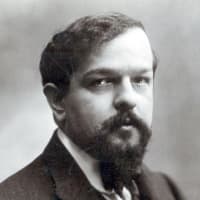
Claude Debussy
Late Romantic · 1862–1918
Claude Debussy entered the Paris Conservatoire at ten, a shopkeeper's son with no musical family behind him, and spent his student years frustrating his teachers by breaking the rules of harmony on purpose. What he was after became clear later: music built on color and atmosphere, with chords chosen for how they sound rather than where the textbook said they should lead.
The result changed French music. The orchestral Prélude à l'après-midi d'un faune, ten quiet minutes from 1894, is often treated as a doorway to modern music, and La Mer paints the sea in three movements without ever imitating it literally. He spent nearly his whole life in Paris and died there in 1918, while the city was under German bombardment.
Begin with the Prélude à l'après-midi d'un faune, then La Mer. Children's Corner, a piano suite he wrote for his young daughter, shows his playful side.
142 works in the catalog, across 5 genres. Log what you listen to with Opus, the classical music journal for iPhone.
Chamber
- Cello Sonata in D minor, L.135
- Sonata for Flute, Viola and Harp, L.137
- String Quartet in G minor, L.85, op. 10
- Violin Sonata in G minor, L.140
- Chansons de Bilitis, for narrator, 2 flutes, 2 harps and celesta, L.96
- Nocturne and Scherzo for Cello and Piano, L.26
- Petite Pièce, for clarinet and piano, L.120
- Piano Trio, L.3
- Premiere Rhapsodie for Clarinet and Piano, L.116
- Syrinx, for solo flute, L.129
Keyboard
- Children's Corner, L.113
- En blanc et noir, for 2 pianos, L.134
- L'isle joyeuse, L.106
- Préludes, Book 1, L.117
- Préludes, Book 2, L.123
- Suite Bergamasque, L.75
- 2 Arabesques, L.66
- 6 Épigraphes antiques, for piano 4-hands, L.131
- 6 Épigraphes antiques, L.131
- Ballade, for piano 4-hands
- Ballade slave, L.70
- Berceuse héroïque, L.132
- D'un cahier d'esquisses, L.99
- Danse bohémienne, L.9
- Divertissement, for piano 4-hands, L.36
- Elégie, L.138
- Estampes, L.100
- Fugue pour le concours d'essai, Prix de Rome Competition
- Fugue pour le concours de fugue
- Hommage à Joseph Haydn, L.115
- Images, Book 1, L.110
- Images, Book 2, L.111
- Images inédites, L.87
- Images oubliees
- Intermède
- La plus que lente, L.121
- Le petit negre
- Le petit nègre, L.114
- Les soirs illuminés par l'ardeur du charbon, for piano
- Lindaraja, for 2 pianos, L.97
- Marche écossaise, sur un thème populaire, for piano 4-hands, L.77
- Masques
- Masques, L.105
- Mazurka, L.67
- Morçeau de concours, L.108
- Nocturne, L.82
- Ouverture 'Diane', for piano 4-hands
- Page d'album, L.133
- Petite suite, for piano 4-hands, L.65
- Pièce san titre
- Pour le piano, L.95
- Première Rhapsodie, for piano
- Rêverie, L.68
- Tarantelle styrienne, L.69
- Valse romantique, L.71
- Étude retrouvée, for piano
- Études, L.136
Orchestral
- Images, L.122
- La Mer, L.109 Three symphonic sketches
- Nocturnes, L.91
- Prélude à l'après-midi d'un faune, L.86
- Danse sacrée et danse profane, for harp and orchestra, L.103
- Fantaisie, for piano and orchestra, L.73
- Intermezzo, for cello and orchestra
- Le martyre de Saint Sébastien, for soloists, chorus and orchestra, L.124 Incidental music
- Le roi Lear, L.107
- Le triomphe de Bacchus
- Première rapsodie, for clarinet and orchestra
- Première Suite, for orchestra
- Printemps, symphonic suite for chorus, piano and orchestra, L.61
- Rhapsody, for alto saxophone and orchestra, L.98
- Suite Bergamasque, no. 3, for orchestra
- Symphony in B minor
Stage
- Jeux, L.126 Ballet
- Pelléas et Mélisande, L.88 Opera
- Khamma, L.125 Ballet
- La boîte à joujoux, L.128 Ballet
Vocal
- 2 Romances
- 2 Romances, L.79
- 3 Ballades de Villon, L.119
- 3 Chansons de Charles d'Orléans, L.92
- 3 Mélodies, L.81
- 3 Poèmes de Mallarmé, L.127
- 5 Poèmes de Baudelaire, L.64
- Aimons nous et dormons, L.16
- Apparition, L.53
- Ariettes oubliées, L.60
- Beau soir, L.6, "Lorsque au soleil couchant les rivières sont roses"
- Berceuse, L.93, "Il était une fois une fée qui avait un beau sceptre"
- Caprice
- Chanson espagnole, song for 2 voices and piano, L.42
- Chansons de Bilitis, L.90
- Chansons de France, L.102
- Coquetterie posthume, L.39
- Dans le jardin, L.78, "Je regardais dans le jardin"
- Fantoches, L.21
- Fleur des blés, L.7
- Flots Palmes Sables
- Fête galante, L.23
- Fêtes galantes, Set 1, L.80
- Fêtes galantes, Set 2, L.104
- Hymnis, for voice, chorus, and orchestra, L.37
- Il dort encore
- Invocation, cantata for male chorus and orchestra, L.40
- Jane
- L'archet
- L'enfant prodigue, scène lyrique for voices and orchestra, L.57
- La belle au bois dormant, L.74
- La damoiselle élue, for womens voices and orchestra, L.62
- La fille aux cheveux de lin, L.33
- La grotte
- La romance d'Ariel, L.54
- Le gladiateur, cantata for 3 soloists and orchestra, L.41, "Mort aux Romains, tuez jusqu'au dernier"
- Le lilas, L.22
- Le Printemps, cantata for women's chorus and orchestra, L.24
- Le promenoir des deux amants, L.118
- Les Angélus, L.76, "Cloches chrétiennes pour les matines"
- Les papillons
- Les roses, L.13
- Madrid, princesse des Espagnes
- Mandoline, L.29
- Musique, L.44
- Noël des enfants qui n'ont plus de maison, L.139
- Nuit d'étoiles, L.4
- Nuits blanches
- Pantomime, L.31
- Paysage sentimental, L.45
- Pierrot, L.15
- Proses lyriques, L.84
- Regret, L.55
- Romance: Silence ineffable
- Romance: Silence ineffable, L.43
- Romance: Voici que le printemps, L.52
- Rondeau, L.30
- Rondel chinois, L.17, "Sur le lac bordé d'azalée"
- Rêverie, L.8
- Serenade
- Souhait, L.11
- Sérénade, song for voice and piano, L.34
- Tragedie
- Trois mélodies de Verlaine
- Zéphyr, L.12
Listening guides
Related composers


Keep a listening journal.
Opus is free on the App Store.