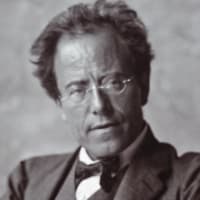
Gustav Mahler
Late Romantic · 1860–1911
Gustav Mahler was born in 1860 in a small Bohemian town and made his living not as a composer but as a conductor, climbing through the opera houses of Europe to the top job: director of the Vienna Court Opera from 1897 to 1907, where his obsessive standards made him admired and resented in equal measure. Composing was crammed into summer holidays, in little huts he built by Austrian lakes.
What he wrote there were symphonies of enormous scale and ambition, often with singers folded in, mixing funeral marches, folk tunes, birdsong, and moments of pure transcendence. He told Sibelius that a symphony must be like the world: it must embrace everything. His last years were spent conducting in New York before his death in Vienna in 1911, and his music, slow to catch on, now anchors the orchestral repertoire.
Start with the Symphony no. 1, then the Symphony no. 5, whose slow Adagietto movement is his most famous single stretch of music.
24 works in the catalog, across 3 genres. Log what you listen to with Opus, the classical music journal for iPhone.
Chamber
- Piano Quartet in A minor
Orchestral
- Symphony no. 2 in C minor, "Resurrection"
- Symphony no. 5 in C sharp minor
- Symphony no. 6 in A minor
- Symphony no. 8 in E flat major
- Symphony no. 9 in D major
- Blumine Symphonic poem
- Symphony no. 1 in D major, "Titan"
- Symphony no. 3 in D minor
- Symphony no. 4 in G major
- Symphony no. 7 in E minor
- Symphony no. 10 in F sharp major
- Totenfeier Symphonic poem
Vocal
- Das Lied von der Erde Symphony for alto, tenor and orchestra
- Des Knaben Wunderhorn Song cycle
- Kindertotenlieder Song cycle
- Rückert-Lieder Song cycle
- Das himmlische Leben Song for voice and orchestra
- Das klagende Lied Cantata
- Drei Lieder Songs
- Lieder eines fahrenden Gesellen Song cycle
- Lieder und Gesänge, vol. 1 Songs
- Lieder und Gesänge, vol. 2 Songs
- Lieder und Gesänge, vol. 3 Songs
Listening guides
Related composers


Keep a listening journal.
Opus is free on the App Store.