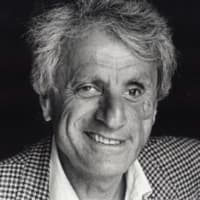
Iannis Xenakis
Post-War · 1922–2001
Iannis Xenakis reached music by an unusual road. Born to Greek parents in Romania in 1922, he studied engineering in Athens, fought in the wartime resistance, and was badly wounded, losing an eye. Under a death sentence after the fighting, he fled to Paris in 1947, where he spent twelve years working for the architect Le Corbusier while teaching himself composition.
Architecture and mathematics stayed in the music. Rather than writing tune and accompaniment, he designed masses of sound, clouds and curves of it, often planning pieces with the same kinds of drawings and calculations he used for buildings. Metastasis, his breakthrough orchestral work of the mid-1950s, sends dozens of string players sliding slowly from note to note along individually plotted paths.
Metastasis is the piece to hear first, and it is short. Then try Psappha, for a single percussionist: all rhythm, attack, and nerve.
62 works in the catalog, across 5 genres. Log what you listen to with Opus, the classical music journal for iPhone.
Chamber
- Pléïades, for 6 percussionists
- Psappha, for percussion solo
- Achorripsis, for 21 musicians
- Akea, for piano and string quartet
- Akrata, for 8 winds and 8 brass
- Aroura, for 12 strings
- Charisma, for clarinet and cello
- Dhipli Zyia, for violin and cello
- Dikhthas, for violin and piano
- Dmaathen, for oboe and percussion
- Embellie, for solo viola
- Hunem-Iduhey, for violin and cello
- Ikhoor, for string trio
- Keren, for trombone
- Kottos, for cello
- La Légende d'Eer, electroacoustic work for 7-channel tape
- Mikka, for violin
- Nomos Alpha, for solo cello
- Nyuyo, for 4 musicians
- Okho, for 3 percussionists
- Paille in the wind, for cello and piano
- Rebonds, for percussion solo
- Roscobeck, for cello and string bass
- ST/4, for string quartet
- Syrmos, for string ensemble of 18 or 36 players
- Tetora, for string quartet
- Tetras, for string quartet
- Theraps, for solo double bass
- Xas, for saxophone quartet
Keyboard
- A.r.
- Evryali, for piano
- Herma
- Khoaï, for harpsichord
- Mists
- Naama, for harpsichord
Orchestral
- Metastasis, for 60 musicians
- Ata, for 89 musicians
- Dox-Orkh, for violin and 89 musicians
- Empreintes, for 85 musicians
- Epicycle, for cello and 12 musicians
- Erikhthon, for piano and 88 musicians
- Hiketides: Les suppliantes d'Eschyle, suite for brass instrument and string orchestra
- Jalons
- Jonchaies, for 109 musicians
- Keqrops, for piano and 92 musicians
- Krinoïdi, for 71 musicians
- Lichens, for 96 musicians
- Noomena, for 103 musicians
- Pithoprakta, for 49 musicians
- Roáï, for 90 musicians
- Shaar, for large string orchestra
- ST/48, for 48 musicians
- Synaphaï, for piano and 86 musicians
- Tracées, for 94 musicians
- Troorkh, for trombone and 89 musicians
Stage
- Antikhthon, ballet for 86 or 60 musicians
Vocal
- A Hélène, for solo female voices, or female chorus or male chorus
- Aïs, for amplified baritone, solo percussion and orchestra
- Nuits, for 12 voices
- Oresteïa, for children's chorus, chorus and 12 musicians
- Serment-Orkos, for chorus of 32 voices
- Zyia, for soprano, male chorus, flute and piano
Related composers


Keep a listening journal.
Opus is free on the App Store.